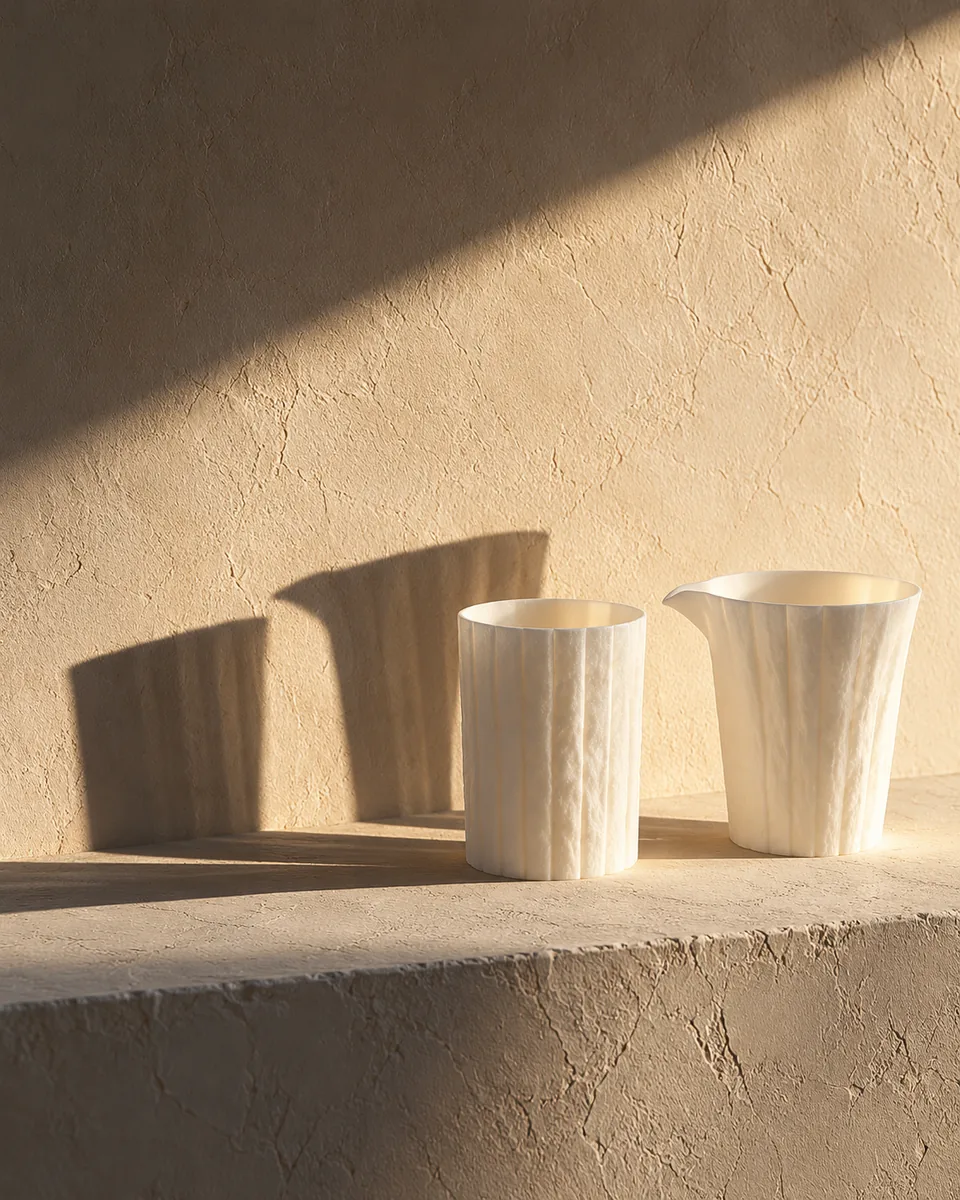
A paper cup made permanent: Dehua porcelain and the folded cups
Updated 14 October 2026
A paper coffee cup lasts about as long as the coffee. Crush it and throw it away, and it is gone. Our folded cups keep that crumpled shape and make it in a white porcelain the seller describes as Dehua's, from a county in Fujian with a very long record of it.
Dehua's white
Dehua is a county in Fujian, in southeast China. Its porcelain is known in the West as blanc de Chine, French for "white from China", and in large quantities it reached Europe as export porcelain in the early 18th century.
The colour comes from the clay. Dehua's porcelain clay holds very little iron. That let potters fire it in an oxidising kiln, one with plenty of air, to a warm white or pale ivory. Jingdezhen porcelain, by contrast, had to be fired in a kiln starved of air to keep it from turning a straw colour. In the Ming dynasty, Dehua's body was called "ivory white" and "milk white".
China lists Dehua's porcelain firing as national intangible heritage, item Ⅷ-11, on the first list of 2006. The record says the craft rose in the Tang and Song dynasties and flourished in the Ming and Qing. It also names two ways of making a piece. One is to shape fine kaolin directly by hand. The other is to make a mould first and then cast or press the clay in it. Glaze is a choice, not a rule: a piece is glazed only if needed, then fired above 1,000 °C. The record also names He Chaozong, a Ming sculptor whose figures, made by pinching, modelling, carving and joining local kaolin, were collected across Europe. In 2021 the Dehua kilns joined UNESCO's World Heritage List as part of the Quanzhou sites.
Paper, in porcelain
Other makers have played with crumpled paper in porcelain too. Revol, a French porcelain maker, sells a "Crumpled Tumbler" fired at 1,320 °C. Our folded cups take the same idea in Dehua's white.
What the seller says about the folded cups
The seller does not name the maker, so here is what the seller states about the pieces.
- The clay. The seller describes it as Dehua porcelain clay from Fujian, low in iron and high in potassium, which in sunlight turns half-translucent, like lard. In strong light you can see it through the pleats.
- No glaze outside. The outside is left unglazed and matte, so the white you see and hold is the porcelain itself.
- Cast, then finished by hand. The seller lists casting openings among the normal marks, which means the pieces are cast in a mould, one of the two routes the Dehua heritage record describes. The seller states each piece is ground by hand before it is fired and polished by hand for about two hours after.
- Small marks. It says small pinholes, bubbles or specks are a normal part of the process.
The pieces are small. The tall cup holds 190 ml (6.4 fl oz), the short cup 175 ml (5.9 fl oz), and the milk pitcher 170 ml (5.7 fl oz), which pours from a pointed spout. None has a handle; you hold them by the folds. Together they make coffee for two, with milk on the side.
What started as a cup you throw away becomes the one you rinse and put back on the shelf.
The pieces in this story
- Folded-Paper Porcelain Cups and Milk Pitcher: tall cup, short cup, milk pitcher
- Folded Coffee Service, the set of all three
- Brush-Painted Cat Cup, made in Dehua