The Jingdezhen saying about seventy-two hands
Updated 14 October 2026
In Jingdezhen there is an old saying about how a piece of porcelain gets made: a single clay body passes through seventy-two hands before it becomes a vessel (共计一坯之力,过手七十二,方克成器). The number belongs to the city's tradition; it is not a count for any one of our cups. The record that keeps the line adds a caveat of its own: even that count leaves out the finer steps.
The number was never meant as an exact tally. It describes a city where the work was split into trades. China's national record of Jingdezhen's handmade porcelain craft lists the chain as it ran in the Ming and Qing dynasties: mining the stone, washing it, preparing and kneading the clay, letting it age, throwing it on the wheel, trimming it, painting the body, glazing, firing in the kiln, painting over the glaze, firing again, sorting and packing. Each step had its own specialists, and a cup moved from one workshop to the next.
Two older inventions sit underneath that system. In the Yuan dynasty, Jingdezhen potters began mixing porcelain stone with kaolin, a two-part recipe for the body, and they began painting in cobalt under the glaze. That is the start of the blue-and-white porcelain most people picture when they hear the city's name.
A city on the World Heritage List
On 25 July 2026, at its 48th session in Busan, UNESCO's World Heritage Committee inscribed the Jingdezhen Handicraft Porcelain Industry Sites. The sites cover the industry that grew there from the 10th to the 19th century. They are China's first industrial heritage site to be nominated, and the first World Heritage site about porcelain. Xinhua's report quotes the American historian Robert Finlay for a sense of scale: in the three centuries after the 1500s, about 300 million pieces of Chinese porcelain reached Europe, most of them from Jingdezhen.
The craft did not stop when the old kilns did. The same report counts more than 100,000 people working in the city's ceramics industry today and over 3,200 recognised bearers of ceramic heritage skills. A heritage bearer quoted by People's Daily Online still describes the work as 72 steps, "from kneading and wheel throwing to trimming, painting, glazing and kiln firing". Independent makers keep arriving too, drawn by low living costs, and a market runs three days a week with free stalls.
What our Jingdezhen sellers say
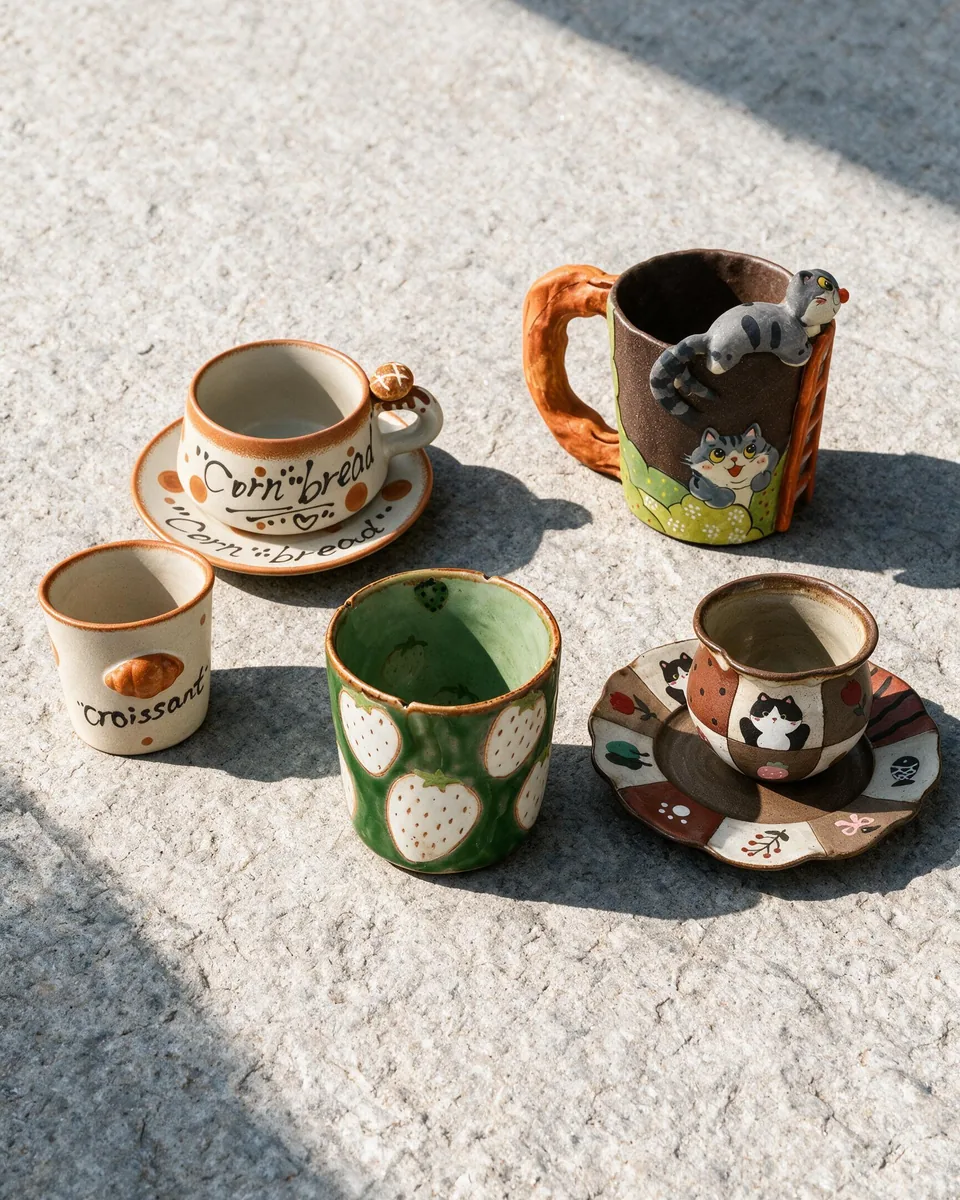
Five of the pieces we carry, from four studios, are made in Jingdezhen by their sellers' own account. Nobody can count the hands that touched any one cup, so here is what each studio says on its own page, and nothing more.
- The Bakery Cat cups: the studio states its cups are made in Jingdezhen from Jingdezhen kaolin and painted by hand under the glaze. A panel on its page quotes 72 steps, 72道工序, which echoes the old saying; the count is the studio's own.
- The Cat Relief Mug and the bakery cups and toast plate: the studio says each picture is painted by a craftsperson and then fired above 1,000 °C.
- The flower-rim cups with painted animals: the studio says the rim is pinched into petals by hand and the panels are painted by hand under the glaze.
- The Strawberry Relief Cup: the studio says the strawberries are raised in relief, painted by hand under the glaze and high-fired, and marks the base with its name.
None of this makes a cup old or rare. It places an everyday cup in a long line of work that a city organised, step by step, for a thousand years.
The pieces in this story
- Bakery Cat Coffee Cups
- Cat Relief Mug
- Bakery Relief Cups and Toast Plate
- Flower-Rim Cup and Saucer with Painted Animals
- Strawberry Relief Cup
Sources
- China Intangible Cultural Heritage, 景德镇手工制瓷技艺 (Jingdezhen handmade porcelain craft), item Ⅷ-7, first list 2006 (read 2026-10-14) ↗:
- Xinhua, "Jingdezhen porcelain sites inscribed on World Heritage List", on the Henan provincial government's English site, 2026-07-25 (read 2026-10-14) ↗:
- People's Daily Online via CFLAC, 2026-08-04 (read 2026-10-14 by the craft research) ↗:
- Sixth Tone, on Jingdezhen's independent makers, 2022-03-03 (read 2026-10-14 by the craft research) ↗: