White slip: the pale coat under a painted cat
Updated 14 October 2026
Slip is clay thinned with water until it pours like cream. Brush it or dip a pot in it, and a dark clay body can wear a pale coat. That simple move gave Korea a whole family of ceramics and gave Japan a word that a studio in southern China now uses for a cup with a cat on it.
Buncheong: a grey pot in a white coat
Buncheong is a Korean stoneware of the Joseon dynasty. The Metropolitan Museum of Art's essay on it places the ware in the first two hundred years of the dynasty, which began in 1392. Potters covered grey clay with white slip and then decorated it in many ways: stamping a pattern and filling it with slip, inlaying, scratching through the white to the grey beneath, painting in iron, brushing, and dipping.
The National Museum of Korea shows one of the loosest of these methods on a bowl in its collection. A brush called a gwiyal swept white slip over the surface, so the brushstrokes stay visible as streaks of white over grey. The ware largely disappeared from Korea after the 16th century and was revived in the 20th.
Kohiki: the whole cup in white
When the white slip covered a piece entirely, the ware went by another name. 粉引, read kohiki in Japanese, began as a Korean ware of the Joseon period, a dark clay body coated all over in white slip.
It found its keenest audience across the sea. Buncheong pieces were exported to Japan by practitioners of the tea ceremony, and a Japanese craft publisher describes kohiki's "relaxed, simple appearance" as having "attracted the hearts of the Momoyama tea masters". Japanese kilns went on to make the style themselves, and the Japanese names stuck: kohiki for the all-white kind, and Mishima, the name buncheong came to be known by in Japan.
So kohiki is a Japanese word for a technique born in Korea. It names a surface, not a country of origin.
The cat cup from Dehua
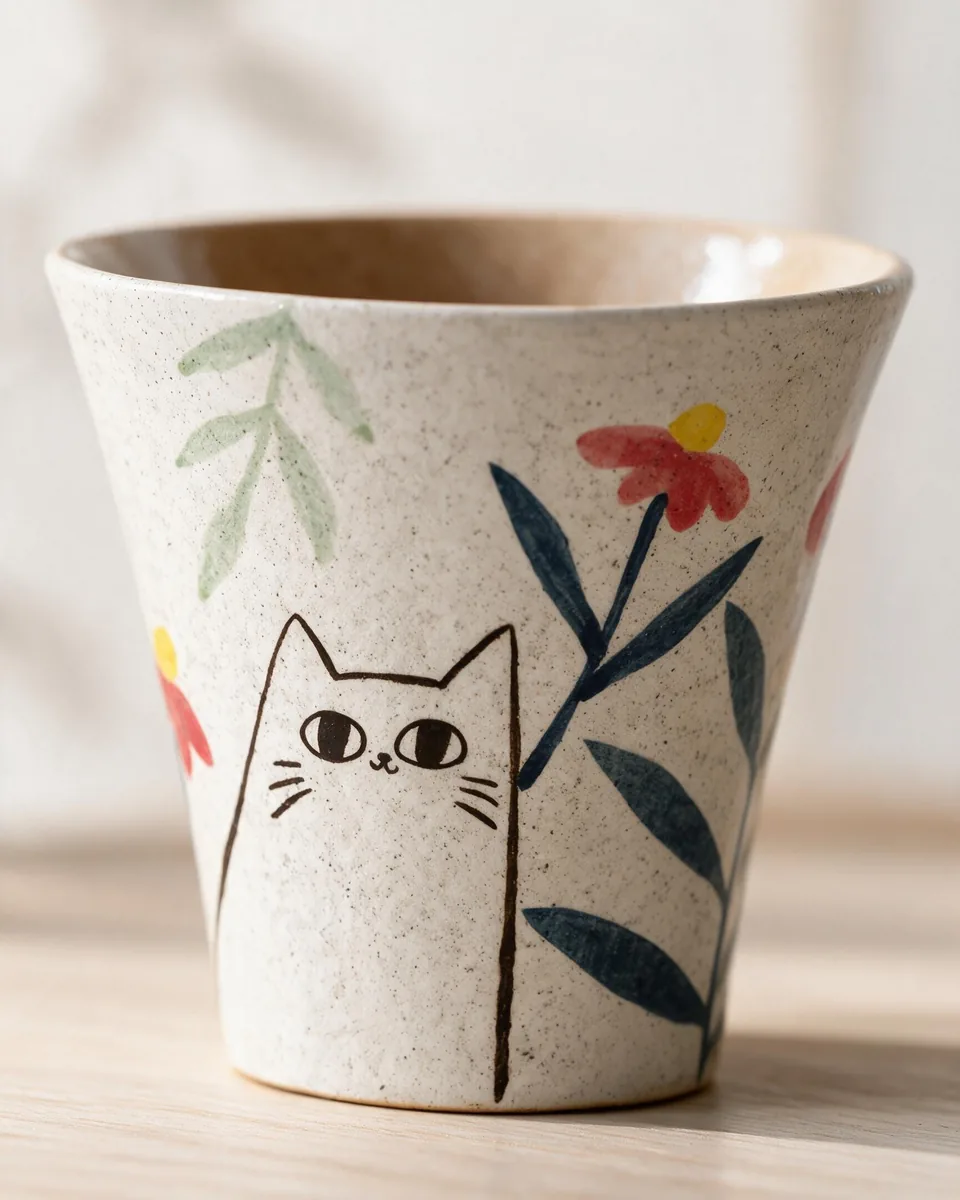
Our Brush-Painted Cat Cup comes from a studio that says it began in 2016 and works in Dehua, Fujian, in China. The studio describes the cup's surface with that same word, 粉引, and says each cat and flower is painted by hand under the glaze. It describes its own aim as joining Asian traditional craft with modern design.
Look closely at the cup and you can see what the white coat does. The cats are drawn in fine line, and the flowers and leaves are filled with soft colour, on a warm white flecked with small dark specks. The narrow foot is left bare. Because every cup is painted by hand, the studio says the drawing, brushwork and colour differ a little from one to the next.
We are careful about what this story claims. The cup is not Korean and not Japanese. It is a Chinese studio's cup that borrows the name of a white-slip surface, and its seller does not describe what clay sits under the slip. What links the three is the idea: a pale coat over clay, and a brush that leaves its trace.
Each cup holds 250 ml (8.5 fl oz) and has no handle. It widens toward the rim and sits easily in two hands.
The pieces in this story
- Brush-Painted Cat Cup: Flower Wall, Spring Meadow
- Two Painted Cats, the set of Flower Wall and Spring Meadow
Sources
- The Metropolitan Museum of Art, Soyoung Lee, "Joseon Buncheong Ware: Between Celadon and Porcelain" (the page refused automated reading on 2026-10-14; its dating was read through a search summary) ↗:
- National Museum of Korea, slip-brushed buncheong bowl (read 2026-10-14 by the craft research) ↗:
- Wikipedia, "Buncheong" (read 2026-10-14) ↗:
- Fudosha, JAPAN QUALITY, "On kohiki vessels" (read 2026-10-14) ↗: