
What is a good gift for a Chinese client, and what should you avoid?
Updated 14 October 2026
Give something well made but not expensive, in red or gold wrapping, and hand it over with both hands at the end of the meeting or meal. Avoid clocks, knives and scissors, white or black wrapping, and sets of four. Expect the gift to be politely refused once or twice before it is accepted.
When and how to give it
Canada's Trade Commissioner Service, which advises companies doing business in China, says gifts are usually given at the end of an introductory meeting or a banquet, and that a visiting team is expected to bring something for its hosts. A single larger gift for the lead of the other side is normal, rather than one for every person in the room.
Give and receive with two hands. The Cultural Atlas, an Australian guide to cultural customs, says a Chinese recipient may decline a gift two or three times out of politeness, and the Trade Commissioner Service advises the giver to keep offering. Do not expect it to be opened in front of you; the Cultural Atlas notes that gifts are usually opened later.
What to avoid
- Clocks. Giving a clock, 送鐘 (sòng zhōng), sounds the same as 送終, seeing someone off at their death.
- Knives, scissors and letter openers. The Trade Commissioner Service says sharp things have bad associations in China.
- Anything in fours. The word for four, 四 (sì), sounds close to the word for death, 死 (sǐ). This rules out a set of four cups, even a beautiful one.
- White or black wrapping. Both are colors of mourning. Red and gold are lucky, and the Trade Commissioner Service also lists dark blue as suitable.
- Something too expensive. Both guides say a gift should not be too costly. If your client works for a government office or a state-owned company, check their rules on gifts before you buy.
Why porcelain works
Porcelain is a safe choice. It is useful, it is easy to carry in a suitcase, and a cup painted by hand shows that someone chose it with care.
Two things change the choice. If you are flying to China to see the client, the Trade Commissioner Service's advice is to bring something from your own country, since a Chinese porcelain cup bought abroad may seem an odd present to take home to China. And a pair is better than a single piece, because there is a Chinese saying that good things come in pairs, 好事成雙 (hǎoshì chéng shuāng).
Pieces that suit a client
- Birds and Horses: two porcelain cups painted by hand, one with flying birds and one with galloping horses, each turning above a ring of metal charms, for an important client.
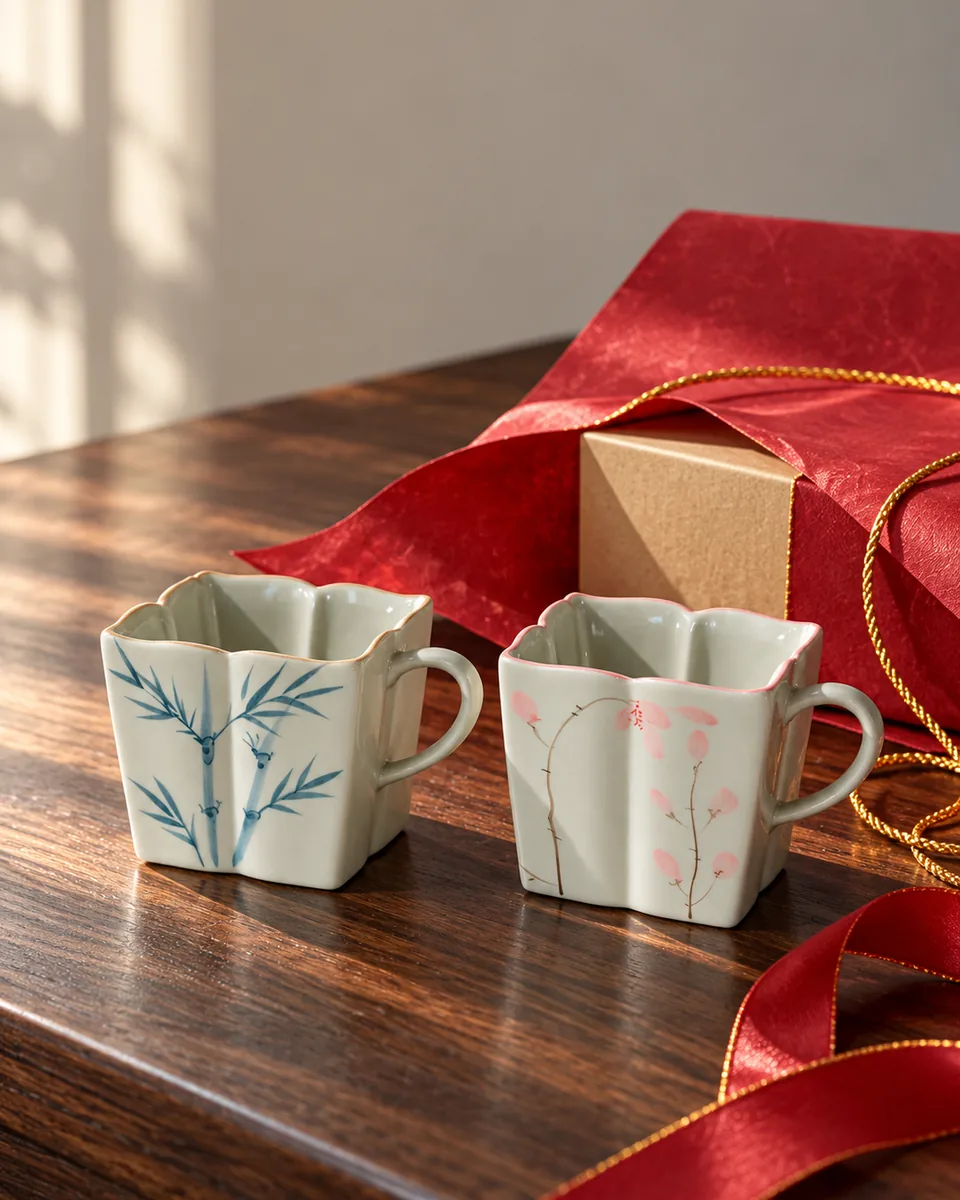
- Square Flower-Rim Cup: the pair of square cups, blue bamboo and pink orchid, in one gift box with a paper bag.
- Crane Tea for Two: a small teapot and two cups in speckled green with silver cranes. Cranes stand for long life in Chinese art, which makes it a good choice for an older client.
The pieces in this story
Sources
- Trade Commissioner Service (Government of Canada), "Business etiquette in China" (read 2026-10-16) ↗
- The Cultural Atlas, "Chinese culture: etiquette" (read 2026-10-16) ↗
- US International Trade Administration, China Country Commercial Guide, business travel (read 2026-10-16) ↗
- The Metropolitan Museum of Art, water dropper in the shape of a crane (read 2026-10-16) ↗