
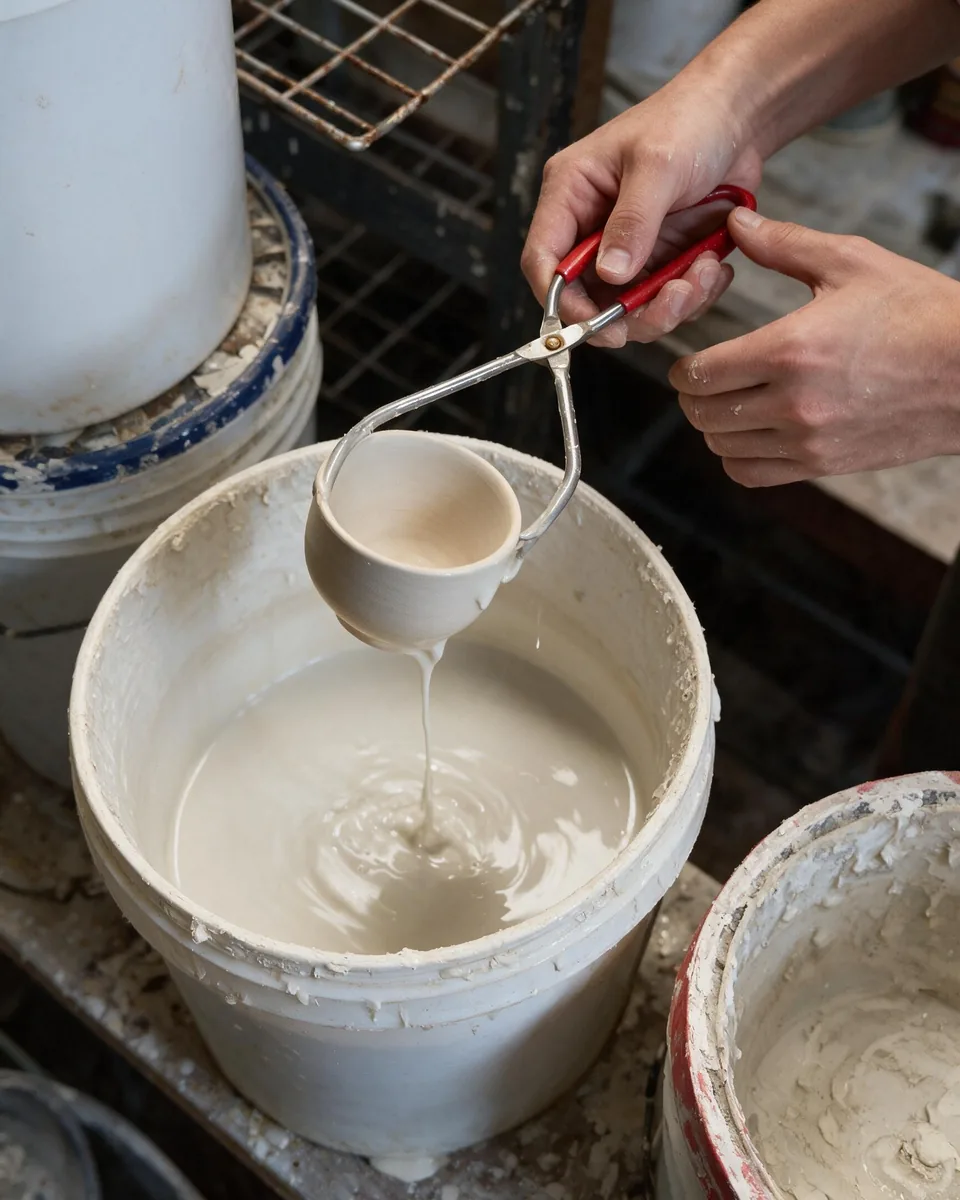
Dipped, sprayed or brushed: how does glaze get onto a cup?
Updated 14 October 2026
Glaze is the glassy coat on a cup, and it goes on before firing in one of a few ways: the cup is dipped in it, glaze is swirled round the inside, it is blown or sprayed on as a fine mist, or it is brushed on by hand. Each way leaves its own small marks, such as a drip, a thicker band at the rim, a bare foot or the direction of a brush. Only one of our makers names a method: the Lamb Cup's, which says its glaze is brushed on by hand.
Dipping
China's national heritage record lists dipping, 蘸釉, among the methods porcelain workshops used widely from the Song dynasty on. In a 1743 account of the imperial porcelain works, Tang Ying wrote that small round pieces were "still glazed by dipping them into" a large jar.
A dipped cup usually gets an even coat. The spot where it was held is left bare unless it is touched up afterwards, and glaze can run as the piece comes out.
Swirling
For the inside of a cup, glaze is poured in, turned until it coats the walls, and poured out again. The heritage record names this method, 蕩釉, beside dipping. It gives an even coat inside, and where the inside glaze meets the outside coat there is often a slightly thicker line at the rim.
Blowing, then spraying
Tang Ying also described a way for pieces too big or awkward to dip. A worker took a bamboo tube about seven inches long, covered one end with fine gauze, dipped that end in glaze and blew it onto the piece, from three or four coats up to seventeen or eighteen, depending on the piece and the glaze. Brushing had never given an even coat on square, tall or ribbed shapes, he wrote, and blowing did.
Today a pump does the blowing, a doctoral study of porcelain crafts found; blowing by mouth was not passed on. Derek Au, a ceramic artist, writes that some craftspeople do nothing but go from workshop to workshop spraying glaze. Their sprayers were made to be blown by mouth; Au runs his from a small air pump. A sprayed coat is built up in thin layers and can be very even, though potters say it takes a lot of practice.
Brushing
Tang Ying already called brushing an older method, and a hard one to make even on most shapes. A modern potters' guide says brushing "often develops an unevenness in the surface coat, purely due to the nature of the process", and that going over the same patch twice leaves streaks. On a cup you can see the direction of the brush, or places where the coat is a little thicker or thinner.
The same doctoral study found that dipping, swirling and brushing now survive mainly as demonstrations for visitors, though workshops still use them to copy Yuan and Ming pieces.
Our Lamb Cup
The Lamb Cup and Saucer's maker says the glaze on every piece is brushed on by hand, so the texture differs from cup to cup. You can see it where the caramel brown of the upper cup streaks into the near-black below. The studio also says the facets are cut by hand and the lamb is decorated under the glaze. The base is left bare. Where the cup is made, the description does not say, and neither do we.
Other makers mention glaze marks without naming a method. The Bakery Relief Cups' studio calls natural glaze runs normal, and the Cat Relief Mug and the Painted Patchwork Hand Cup leave their feet unglazed so they grip the table.
The pieces in this story
Sources
- China Intangible Cultural Heritage, handmade porcelain craft, item Ⅷ-7 (read 2026-10-15) ↗
- Tang Ying, Twenty Illustrations of the Manufacture of Porcelain, 1743, Bushell's translation (read 2026-10-15) ↗
- 王麗 (Wang Li), doctoral thesis summary, Kanagawa University (read 2026-10-15) ↗
- Derek Au, "Spraying Glaze", 2016-03-04 (read 2026-10-15) ↗
- Ceramic Arts Network, "8 Ways to Apply Glaze" (read 2026-10-15) ↗