
Kohiki, yohen, mentori: the Japanese and Korean names for the craft on our cups
Updated 14 October 2026
Kohiki, buncheong, yohen, mentori, tebineri and rokuro are the names Japanese and Korean potters use for hand methods you will also find on our cups. Kohiki is a coat of white slip under a clear glaze. Buncheong is the Korean stoneware that coat comes from. Yohen is a color change made by the kiln's own fire, mentori is a set of facets cut into soft clay, tebineri is shaping by hand, and the rokuro is the potter's wheel. Each word names a method, and none of them tells you where a cup was made.
Why we print the names
Gallery labels, ceramics magazines and tea shops in the US often use the Japanese word for a method rather than an English one. A buyer who has handled a kohiki cup will know what "a coat of white slip under the glaze" means as soon as they see the word. So each piece's page gives the method in plain English first, with its Japanese or Korean name beneath.
Kohiki (粉引): a white coat under the glaze
A kohiki surface has three layers: the clay body, a coat of white slip, and a clear glaze over both. The Japanese craft shop Musubi Kiln describes it this way and notes that the slip gives a soft, warm white that shifts a little with each firing. The Metropolitan Museum of Art holds a kohiki sake bottle by the potter Tsujimura Shirō. Our Journal entry on white slip follows the method from Korea to Japan.
Buncheong (분청): the Korean original
Buncheong is Korean stoneware that was coated in white slip before it was decorated. A label at the Princeton University Art Museum calls it "powdered celadon", the successor to the fine celadons of the Goryeo dynasty, and says production ended around 1580. Potters stamped the white coat, inlaid it, scratched through it to the gray clay beneath, brushed it on in loose strokes or dipped the whole pot. The Asian Art Museum in San Francisco has a buncheong jar in its collection.
Yohen (窯変): what the fire decides
Yohen means "kiln change". Musubi Kiln defines it as changes in a piece's color and shape that happen inside the kiln, caused by the flame, the ash and where the piece sits during firing, so the effect comes from the fire and not from a brush. It began as an accident, and potters can now aim for it on purpose. No two cups from the same firing come out exactly alike.
- Speckled Cup and Saucer with Raised Painted Motifs: the heat moves the glaze color, so the tone and speckle differ on every cup.
Mentori (面取り): facets cut by hand
Mentori is the cutting of flat planes into a rounded pot while the clay is still soft, so the curves turn into angled faces. The same word names the bevelled edge of a post or a shelf in Japanese building, according to JAANUS, the dictionary of Japanese art terms kept at Columbia University. On a cup, each cut catches the light at its own angle.
Tebineri (手捻り): shaped in the hands
Tebineri is forming clay by hand, without a wheel. Musubi Kiln describes it as joining coils of clay into a single shape, which leaves an uneven surface that a machine would not make. The word means "twisting by hand", and potters also use it for smaller hand work such as pinching a rim into petals.
- Flower-Rim Cup and Saucer with Painted Animals: the petal rim is pinched into shape by hand.
- Animal Handle Cup and Saucer: the pinch marks are left on the walls on purpose.
Rokuro (轆轤): the wheel
Rokuro is the Japanese word for the potter's wheel. The TKG Japanese-English Learner's Dictionary defines it as "a rotating disc used by potters to shape clay", and the same word also means a woodturner's lathe. On a cup, fine rings running round the body show that it was thrown on a wheel.
- Painted Patchwork Hand Cup: the throwing lines stay visible, and iron in the clay fires into small dark specks.
- Wild Frost Cup and Saucer: fine throwing lines from the wheel stay on the body.
- Green Apple Footed Cup and Saucer: the throwing lines and the bare clay foot show the hand that made it.
What the names do not say
A Japanese or Korean word on one of our pages names a method. It does not mean the cup is Japanese or Korean. It tells you how the cup was made: coated in slip, changed by the fire, cut by hand or pinched into shape.
The pieces in this story
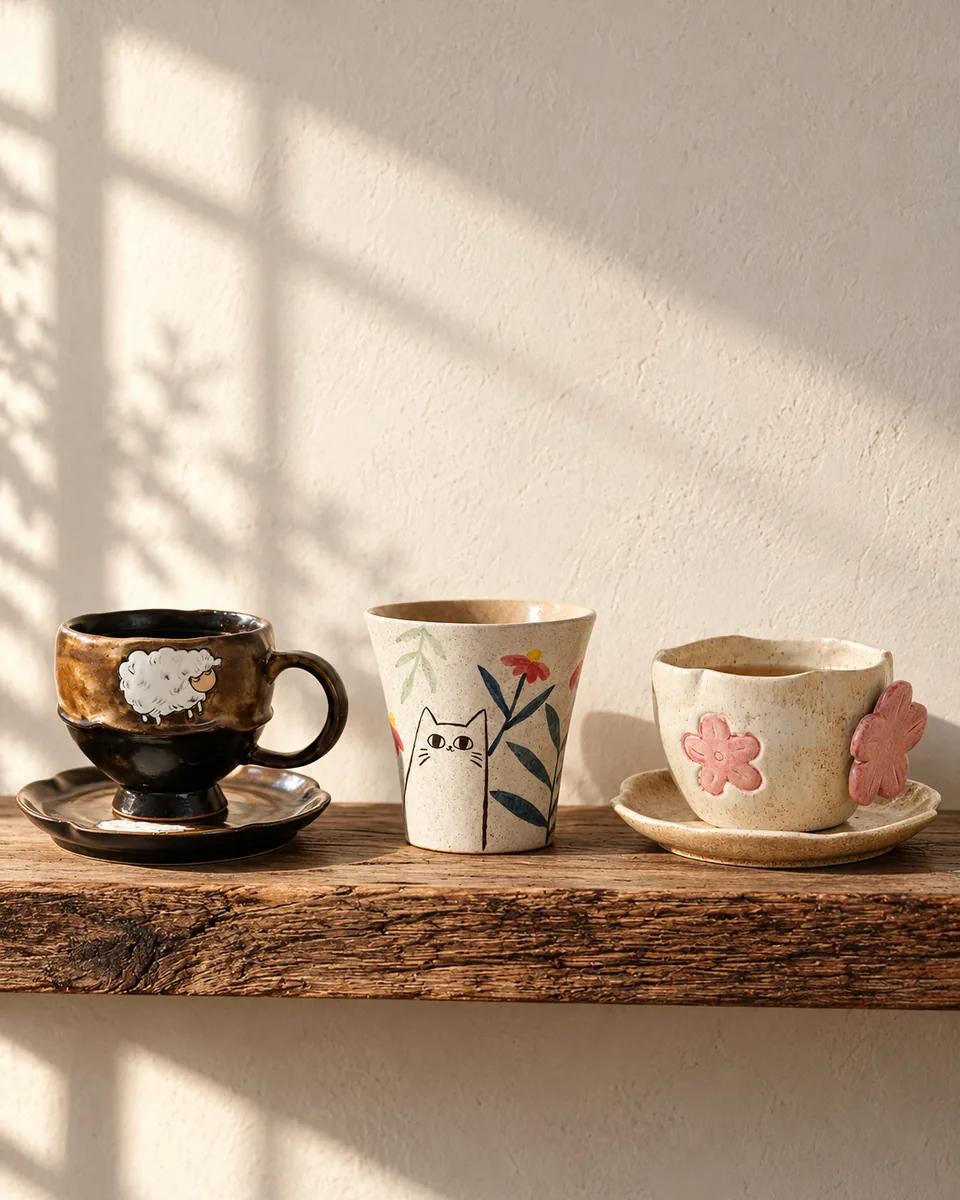
- Brush-Painted Cat Cup
- Speckled Cup and Saucer with Raised Painted Motifs
- Lamb Cup and Saucer
- Flower-Rim Cup and Saucer with Painted Animals
- Animal Handle Cup and Saucer
- Painted Patchwork Hand Cup
- Wild Frost Cup and Saucer
- Green Apple Footed Cup and Saucer
Sources
- Musubi Kiln, glossary entries "Kohiki", "Yohen", "Mentori" and "Tebineri" (read 2026-10-17) ↗
- The Metropolitan Museum of Art, Tsujimura Shirō, Sake Bottle (cited on our questions page; the page refused automated reading on 2026-10-17) ↗
- Princeton University Art Museum, buncheong bowl, label by Sol Jung (read 2026-10-17) ↗
- Asian Art Museum, San Francisco, buncheong jar (cited on our questions page; the page refused automated reading on 2026-10-17) ↗
- JAANUS, Japanese Architecture and Art Net Users System, Columbia University, "mentori" (read 2026-10-17) ↗
- TKG Japanese-English Learner's Dictionary, 轆轤 (rokuro) (read 2026-10-17) ↗