
Why does a hand-painted cup cost more?
Updated 14 October 2026
A hand-painted cup costs more because a skilled person paints every one, one at a time, and when a painted cup fails in the kiln, the painter's hours are lost with it, so the cups that survive carry the cost of the ones that did not. A printed cup skips the painter. We give no figure for how many hours one cup takes or how many are lost, because we found no reliable one.
One cup, one painter
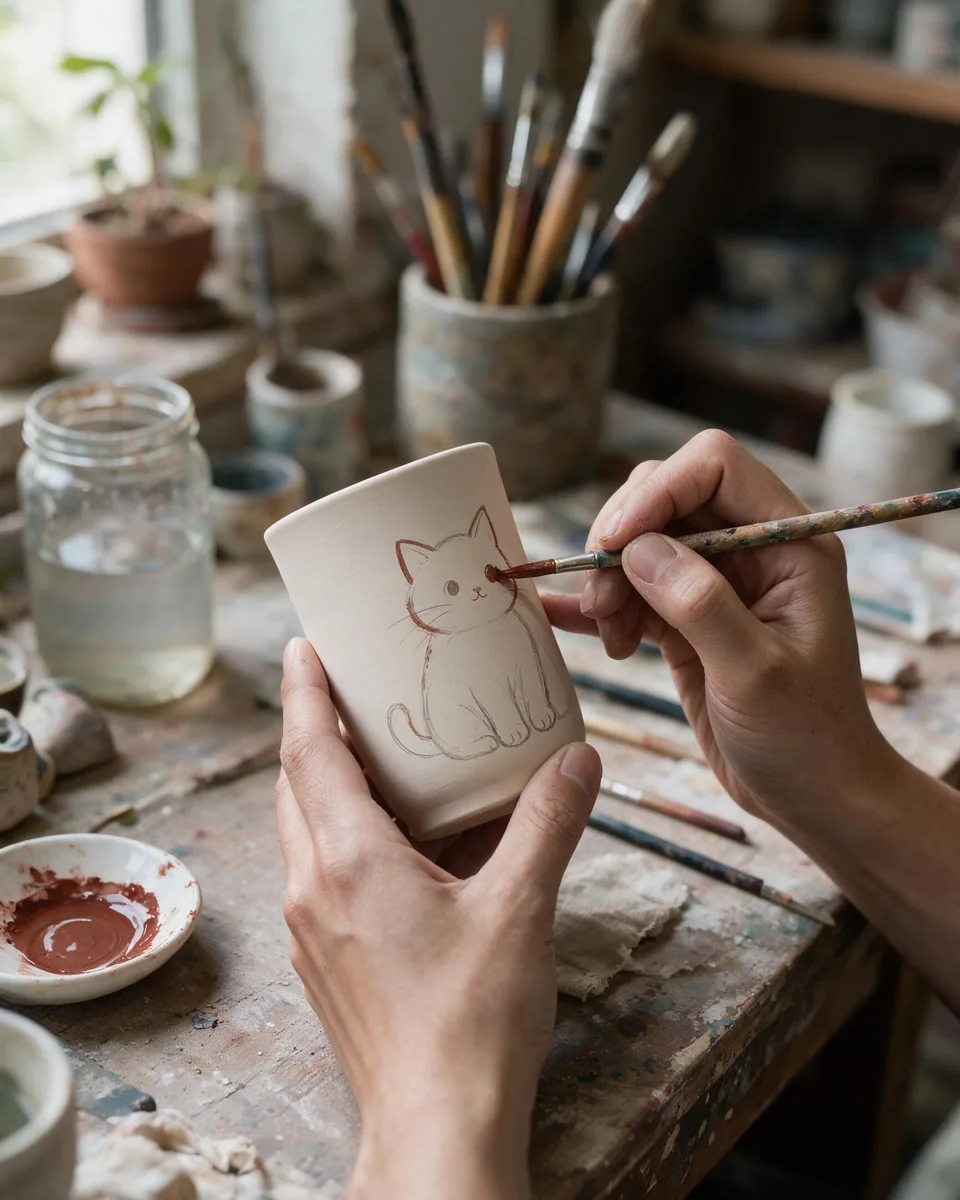
On a hand-painted cup, someone holds each piece and draws on it, and the brush leaves marks a print would not. With underglaze painting the color goes onto the clay before the glaze and cannot be corrected after the firing. In 1712 the French Jesuit François Xavier d'Entrecolles watched porcelain painters at work and noted that the blue looked "a pale black" as it went on, then vanished under the raw glaze until the fire brought it back. So the painter cannot see the finished color until the cup comes out of the kiln.
People's Daily, writing about porcelain painters, says a piece can take "an hour, a day, a year or even many years", which is a range across every kind of work, not a figure for a cup. Royal Copenhagen, in Denmark, says one of its hand-painted dinner plates takes 1,197 brush strokes. That is a factory's claim about its own pattern, not a figure for one of our cups.
What "seventy-two hands" means
You may see the number 72 on porcelain studios' pages; it echoes a line in Tiangong Kaiwu, a Chinese technical encyclopedia first printed in 1637, which says a piece "passes through seventy-two hands before it becomes a vessel" and admits that even that leaves out the finer steps. It stands for a city of specialists, not a count of one cup's steps.
The kiln takes its share
D'Entrecolles saw that a firing was rarely a full success and was sometimes lost entirely. Pieces with even a small fault were rejected, so "the pieces that are taken carry the cost of those that are rejected". He was writing about porcelain for Europe more than three hundred years ago, and losses still enter a price the same way.
Why no two match
Because a person paints each one, the same design comes out a little different every time, and our makers say so.
- The Apple-on-the-Rim Cup: the studio says the painting differs slightly between the workers who paint it.
- The Flower-Rim Cup and Saucer with Painted Animals and the Painted Patchwork Hand Cup: their studio says painting, color and size differ between cups of the same design, and you receive one at random.
- The Brush-Painted Cat Cup: the studio says drawing, brushwork and color differ a little on every cup.
A few cups in our shop carry fired-on decals or printing, and their pages say so; we do not call those hand-painted.
The pieces in this story
- Apple-on-the-Rim Cup
- Flower-Rim Cup and Saucer with Painted Animals
- Painted Patchwork Hand Cup
- Brush-Painted Cat Cup
Sources
- François Xavier d'Entrecolles, letter of 1 September 1712 (read 2026-10-15) ↗
- China Intangible Cultural Heritage, handmade porcelain craft, quoting Tiangong Kaiwu (read 2026-10-15) ↗
- Wenhui Daily, 2016-05-14, quoting the full line (read 2026-10-15) ↗
- People's Daily, 2024-07-27, p. 8 (read 2026-10-15) ↗
- Royal Copenhagen, Blue Fluted Half Lace plate 22 cm (read 2026-10-15) ↗