
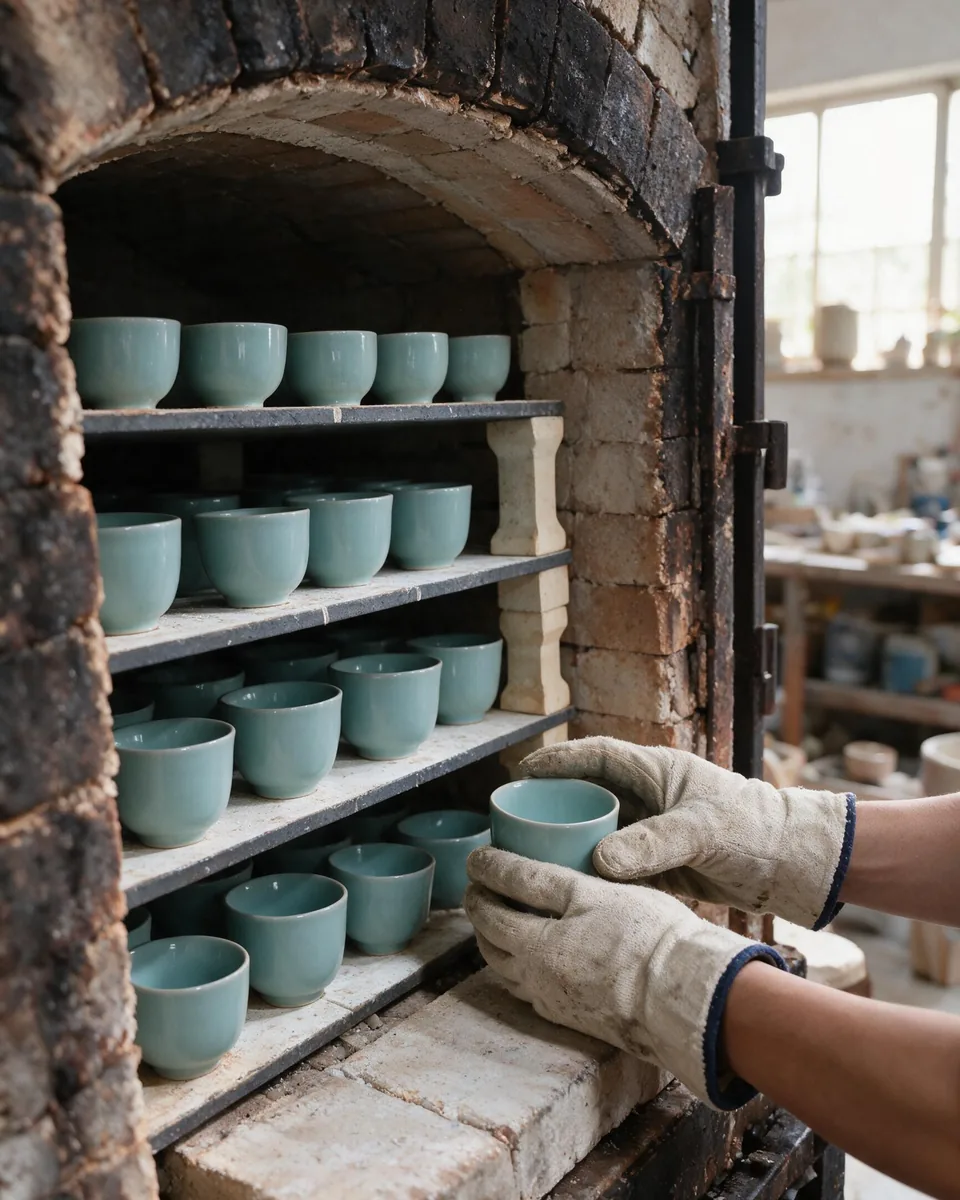
Into the kiln: what does high firing do to a cup?
Updated 14 October 2026
High firing takes porcelain to around 1,300 °C, hot enough for the glaze to melt into a layer of glass and for the clay beneath it to harden. The heat and the amount of air inside the kiln also shift colors. For that reason two cups from the same firing never come out quite alike, and some do not come out whole at all.
How hot is high
The British Museum gives "about 1280–1320 °C" for a Yuan-dynasty porcelain dish. The V&A allows a wider range for hard-paste porcelain in general, from 1,200 up to 1,450 °C.
At those temperatures the glaze melts and turns to glass, and anything painted under it ends up sealed inside. Very few colors survive the heat; the V&A calls cobalt blue "the most reliable" of them.
Air matters as much as heat
"The two most fundamental aspects of firing are the temperature and the amount of oxygen in the kiln atmosphere," the V&A writes. When a kiln is starved of oxygen, which potters call reduction, metals in the glaze behave differently: copper fires red in reduction and green when the kiln has plenty of air. Traditional blue-and-white porcelain was fired that way, the Palace Museum in Beijing says. Because electric kilns normally fire with plenty of air, the same glaze can look different from an electric kiln than from a gas or wood one.
One color in, ten thousand out
Chinese potters have a saying for glazes that change in the fire: 入窯一色,出窯萬彩, "one colour goes in, ten thousand come out". The effect is called 窯變, kiln change. A People's Daily feature lists what drives it, from the kiln's design to the temperature, the air and how thickly the glaze went on.
No two places in a kiln are the same
The historian Robert Finlay records differences of as much as 600 °C between the firebox and the chimney of old dragon kilns, and People's Daily puts the spread inside older wood and coal kilns at 100 to 150 °C.
A wood firing takes about 50 to 60 hours. Many porcelain workshops today fire in small and medium gas and electric kilns. An artist who built a Ming-style wood kiln told China Daily that those "have a high firing success rate", while a wood kiln is "hard to control precisely".
What the kiln takes
The French Jesuit François Xavier d'Entrecolles, who watched porcelain being made in 1712, wrote: "It is also rare for a furnace firing to be entirely successful, as often it is entirely lost." He blamed fierce fires, bad weather and poor wood, among other things. None of the sources we read gives a reliable figure for how many pieces a modern kiln loses.
What our makers say about the fire
- Wild Frost and the Green Apple Footed Cup. Both descriptions say the glaze flows naturally in the fire, and that color can vary with where each cup sat in the kiln.
- The Speckled Cup and Saucer with Raised Painted Motifs. Its studio describes a kiln-change glaze, so the tone and speckle differ on every cup.
- The Bakery Cat Coffee Cups. The studio says the kiln decides the final glaze color, and gives its firing as 1,300 °C over 48 hours.
- The Square Flower-Rim Cup. The studio fires it at about 1,300 °C and says the porcelain shrinks in the kiln, so the four folds of the rim never line up perfectly.
The temperatures in that list are the makers' own; we have not measured them.
The pieces in this story
- Wild Frost Cup and Saucer
- Green Apple Footed Cup and Saucer
- Speckled Cup and Saucer with Raised Painted Motifs
- Bakery Cat Coffee Cups
- Square Flower-Rim Cup
Sources
- British Museum, Room 95 guide, Chinese ceramics (read 2026-10-15) ↗
- V&A, "An A–Z of Ceramics" (read 2026-10-15) ↗
- Palace Museum, Beijing (read 2026-10-15) ↗
- Digitalfire, "Reduction firing" and "Oxidation firing" (read 2026-10-15) ↗
- Robert Finlay, "The Pilgrim Art", Journal of World History, 1998 (read 2026-10-15) ↗
- People's Daily 人民周刊, 2018-09-21 (read 2026-10-14) ↗
- d'Entrecolles, letter of 1712 (read 2026-10-15) ↗
- 文藝報, 2026-08-16, and China Daily HK, 2024-05-16 (read 2026-10-15) ↗